Being prepared
Ready for space weather, ready for anything
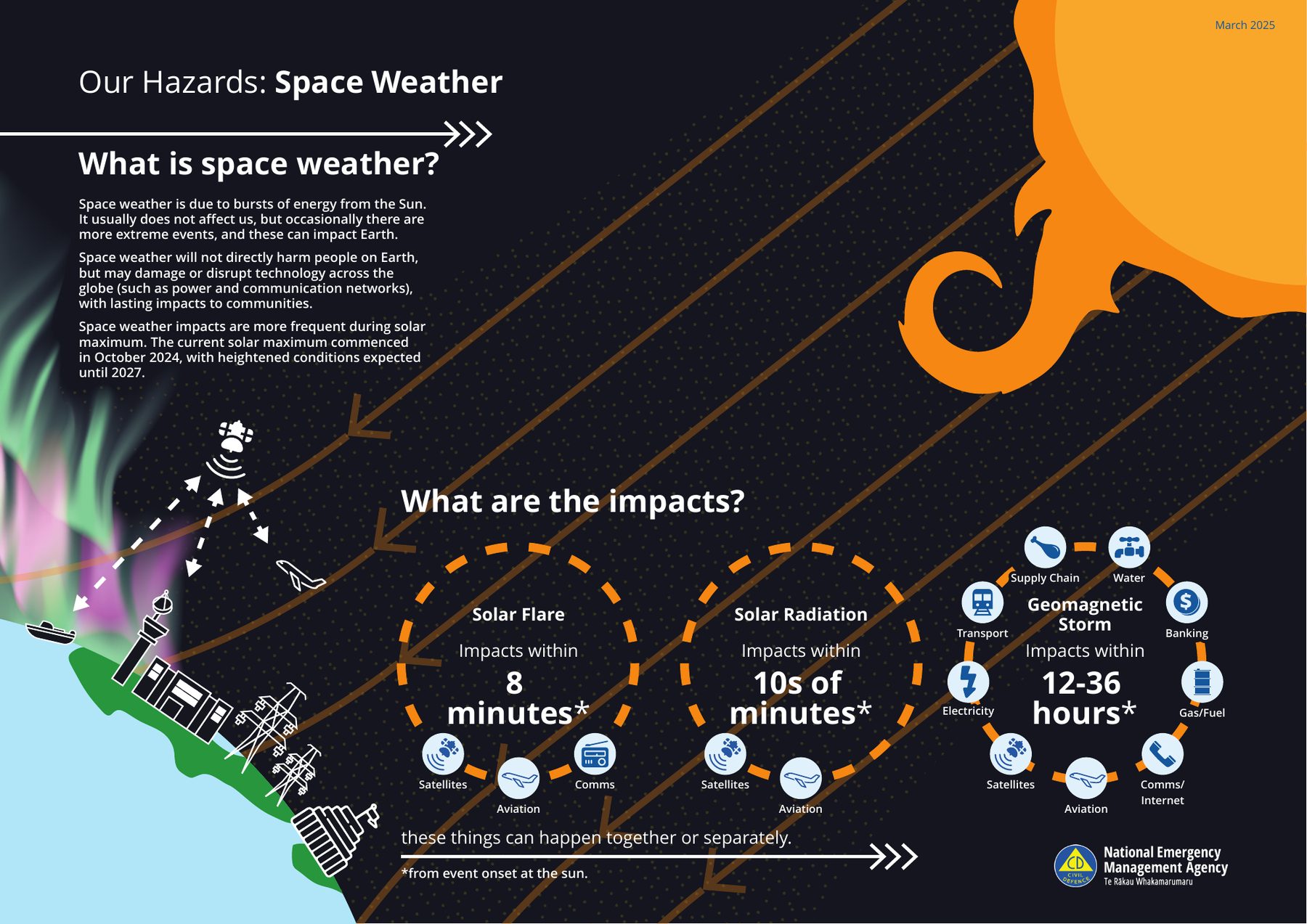
Good news first: space weather can't hurt people or animals, and the big ones usually give us half a day to a day or more of warning (unlike earthquakes, which are terrible at RSVPs). What a rare extreme storm can do is leave us without power for several days (NEMA plans for up to six). The plan and kit that get you through that are the same ones that get you through an earthquake, a flood or a big storm, so getting ready for one gets you ready for all of them.
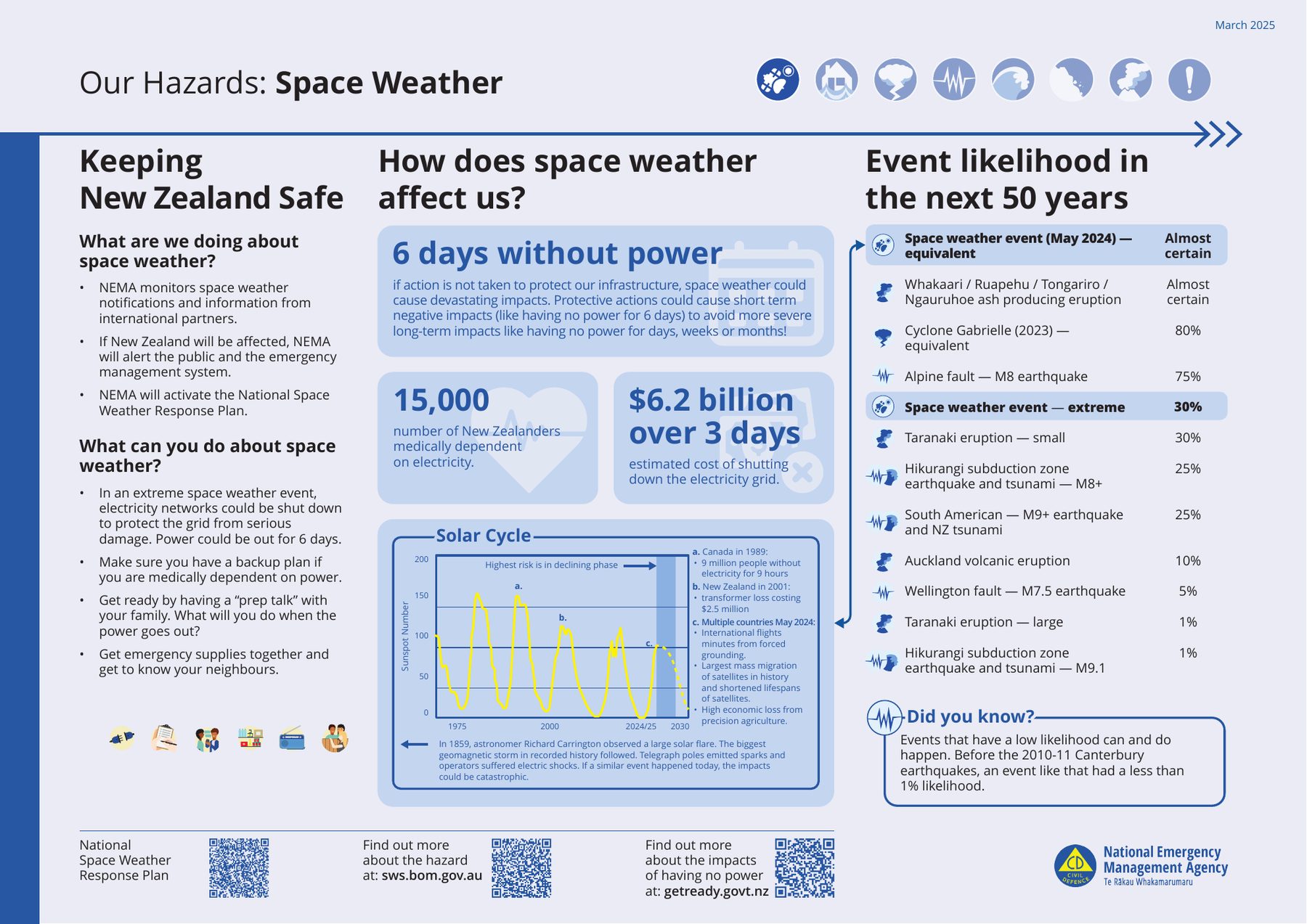
NEMA's estimates for some of New Zealand's natural hazards. Space weather is in orange.
- A space weather event like May 2024SpaceAlmost certain
- An ash-producing eruption at Whakaari, Ruapehu, Tongariro or NgāuruhoeAlmost certain
- An event like Cyclone Gabrielle (2023)80%
- An Alpine Fault M8 earthquake75%
- An extreme space weather eventSpace30%
- A small Taranaki eruption30%
- A Hikurangi M8+ earthquake and tsunami25%
- A South American M9+ earthquake sending a tsunami our way25%
- An Auckland volcanic eruption10%
- A Wellington Fault M7.5 earthquake5%
- A large Taranaki eruption1%
- A Hikurangi M9.1 earthquake and tsunami1%
Low odds don't mean never. Before the 2010–11 Canterbury earthquakes, NEMA notes, an event like that had a less than 1% likelihood.
Source: NEMA, Our Hazards: Space Weather (March 2025)
If the power goes out
Keep your phone charged (your car can help) and save calls for the important stuff. A battery or car radio will keep you in the loop. Eat what's in the fridge first, then the freezer. Never use a barbecue, camp cooker or patio heater indoors. And follow what Civil Defence and the emergency services are telling you.
NEMA and Civil Defence
The National Emergency Management Agency keeps an eye on alerts from space weather centres overseas. If New Zealand is in line for a big one, it tells the public and the emergency management system, and puts the National Space Weather Response Plan into action.
Expert advice comes from the Aotearoa New Zealand Space Weather Science Advisory Panel, a group of local scientists who help read what's coming.
Transpower
Transpower watches space weather alongside the regular kind. In a severe storm it may work with the industry to switch off parts of the grid, so transformers don't get damaged, then bring the power back once the storm has passed. A short planned outage beats waiting months for a replacement transformer.
In Transpower's words, the risk of an extreme event is small, most people don't need to worry, and you can enjoy the aurora when it shows up.
Space weather and the power system on Transpower's website
Things worth doing (to prepare for any emergency)
- Make a household planWho's where, how you'll get in touch, where you'll meet. The Get Ready planner walks you through it step by step.
- Have at least 3 days of suppliesWater, food you can cook without power, torches, batteries, a battery or solar radio, medication, and some cash (EFTPOS needs power too). Don't forget the pets.
See the full list
- Water: at least 9 litres per person, for drinking and basic hygiene over 3 days
- Food: long-lasting food that doesn't need cooking (or a camp stove or gas barbecue to cook on outside), plus food for babies and pets
- Medication: enough of any medication, medical equipment or special dietary needs for 3 days or more
- First aid kit
- Hygiene: toilet paper, hand sanitiser, and buckets with lids and liners for an emergency toilet
- Light and news: torch, a battery or solar radio, and spare batteries
- Power for your phone: a portable charger (and your car can help)
- Cash: coins and small notes, in case EFTPOS and ATMs are down
- Protection: work gloves and a P2 or N95 mask
- Something to do: a pack of cards, a book or a board game, for when the screens are off
- Grab bag: walking shoes, warm clothes, a raincoat, copies of important documents and photo ID
Based on Get Ready's emergency supplies advice
- Plan for medical needsIf someone in your home relies on electricity for medical reasons, have a backup plan and let your power retailer know.
- Know your neighboursThey're the people closest to you when it matters. A chat over the fence now makes it much easier to check on each other later.
- Have a prep talkTen minutes with the whānau about what you'd do if the power was out for days. Bonus points for finding the torch before you need it.
Official information and documents

- Our Hazards: Space Weather PDFThe public infographic, March 2025
- National Space Weather Response Plan PDFVersion 2.0, November 2024
- About the response planNEMA news, December 2024
- Space Weather Science Advisory Panel PDFTerms of reference, August 2025
- Find your local Civil Defence groupContacts for your region

- Space weatherWhat to do before, during and after
- Without power for daysTips for getting through a long power cut
- Emergency suppliesWhat to have at home, at work and in the car
- My household planOnline planner you can print
- getready.govt.nzEvery hazard, from earthquakes to wildfires
More information
 Space weather and the power systemHow Transpower protects the grid
- May 2024 storm: response and lessons PDFEvent summary
 If you rely on electricity for medical reasonsElectricity Authority
 Solar Tsunami Endeavour ProgrammeUniversity of Otago research
 NOAA Space Weather Prediction CenterLive forecasts and alerts